If you’ve ever spent hours building backlinks — guest posts, niche edits, directory listings, PBN links — only to check Google weeks later and find half of them nowhere in the index, you already know the frustration this article is about.
Building a link is only step one. Getting Google to actually crawl the page, understand it, and add it to its index is a separate job entirely, and it doesn’t happen automatically just because a link exists. This is exactly why so many SEOs and affiliate marketers search for how to index backlinks fast in Google — because a backlink that Google hasn’t indexed is, for all practical purposes, invisible to your SEO efforts.
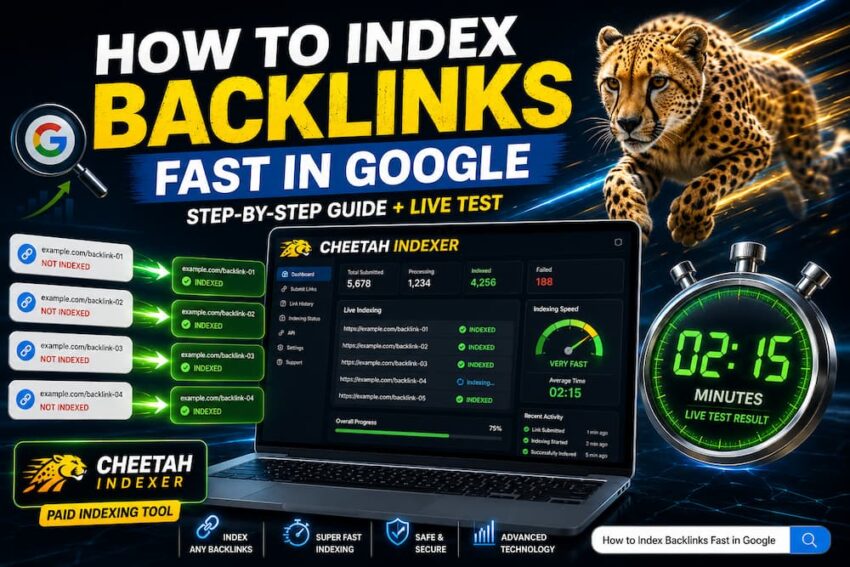
In this guide, I’ll walk through how backlink indexing actually works, why some links get picked up in hours while others sit unindexed for weeks (or never get indexed at all), and what you can realistically do about it. I’ll also share a hands-on test I ran with a paid backlink indexing tool called Cheetah Indexer, which I documented in a video on my YouTube channel — including the actual result, not a marketing promise.
Let’s get into it.
👉 Also Read: How High-Quality Paid Backlinks Can Boost Your SEO?
What Is Backlink Indexing?
Backlink indexing is the process by which Google discovers, crawls, and stores a webpage — the one that contains your backlink — inside its index, so that page (and the link on it) becomes part of what Google actually “knows about” and can potentially factor into its ranking systems.
It helps to separate three distinct things that people often lump together:
- Creating a backlink — you (or someone else) publish a link to your site on another webpage.
- Google crawling that page — Googlebot visits the URL and reads its content.
- Google indexing that page — Google decides to store the page in its index.
A backlink can exist for months without ever being crawled, especially if it sits on a low-authority site that Google rarely visits. And even after Google crawls a page, it doesn’t automatically index it — plenty of crawled pages still get excluded for quality or relevance reasons.
One clarification that’s important to make early: indexing is not the same as ranking. An indexed backlink simply means Google is aware the page (and the link on it) exists. It does not mean that link is automatically going to boost your rankings. Ranking depends on a much longer list of factors — link quality, relevance, anchor text, the linking site’s authority, and dozens of other signals.
How Does Google Discover Backlinks?
Google doesn’t index backlinks directly — it indexes the pages that contain them. The backlink just comes along for the ride once that page is in the index. Roughly, the process looks like this:
- Discovery — Google becomes aware a URL exists, usually by finding a link to it from another page it already crawls, through an XML sitemap, or through a direct submission (like Google Search Console).
- Crawling — Googlebot visits the URL and downloads its content.
- Rendering and evaluation — Google processes the page’s content, structure, and signals to understand what it’s about.
- Indexing decision — Google decides whether the page is worth adding to its index.
- Link discovery — once indexed, any links on that page (including yours) become part of Google’s link graph.
This entire pipeline can take anywhere from minutes to months, and Google itself has never guaranteed a specific timeline for any of these steps. Google’s own crawling and indexing behavior is controlled entirely by Google’s systems, not by webmasters or third-party tools, and it varies enormously based on the site in question.
Why Are Some Backlinks Not Indexed Quickly?
If you’ve noticed that some of your backlinks get indexed within a day while others sit untouched for weeks, it’s rarely random. A few factors tend to explain most of the difference:
- Website authority — Established, frequently crawled domains get new pages picked up faster than brand-new or low-authority sites.
- Page quality — Thin, duplicate, or low-value content is less likely to be prioritized for indexing.
- Crawlability — If Googlebot can’t easily access or parse the page (broken navigation, JavaScript-heavy rendering, slow load times), crawling gets delayed.
- Internal linking — Pages that are well-linked internally on the host site are easier for Google to find and re-crawl.
- Site structure — A messy or orphaned URL (one with no internal links pointing to it) is harder for Google to discover.
- New or low-activity websites — Sites Google rarely visits will naturally have long crawl gaps.
- Noindex directives — If the page has a
noindexmeta tag, Google will crawl it but deliberately exclude it from the index. - Robots.txt restrictions — If the page is disallowed in robots.txt, Googlebot may not even be able to crawl it.
- URL accessibility — Broken links, redirect chains, or server errors all slow things down.
- Google’s own crawling patterns and priorities — Google allocates crawl budget based on its own evaluation of a site’s importance and update frequency, and this is something no external tool can override.
Understanding these factors matters because most “fast indexing” tactics are really just addressing one or two of these bottlenecks at a time.
How to Index Backlinks Fast in Google
There’s no single trick that indexes every backlink instantly — anyone who tells you otherwise is oversimplifying how Google works. That said, there are legitimate, practical steps that can meaningfully improve your odds of faster discovery and indexing.
1. Publish backlinks on crawlable pages Before worrying about indexing speed, make sure the page hosting your backlink is technically accessible — no noindex tags, no robots.txt blocks, and a clean HTTP 200 status.
2. Create useful, original content around the link Pages with thin or spun content are frequently deprioritized. If you have any influence over the guest post or article hosting your link, push for genuinely useful, well-written content.
3. Improve internal linking on the host site If it’s your own site or a site you have some control over, linking to the new page from other established pages helps Google find it faster.
4. Build relevant supporting links A backlink that itself has a few relevant links pointing to it tends to get discovered faster than one sitting in isolation.
5. Make URLs easy to discover Submit an updated sitemap, avoid deep or orphaned URL structures, and keep your site architecture logical.
6. Use Google Search Console for sites you control If you own or manage the linking site, GSC’s URL Inspection tool lets you request indexing directly. This only works for properties you’ve verified — it’s not usable for third-party guest posts or links on sites you don’t control.
👉 Also Read: 10 Best SEO Tools in 2025 – Tools To Improve Your SEO Strategy
7. Monitor whether pages are actually getting indexed Use the site: search operator, Search Console coverage reports, or a dedicated indexing checker to track progress instead of assuming.
8. Use third-party indexing tools carefully For backlinks on sites you don’t own — which is most of what link builders deal with — a backlink indexing tool can help signal these URLs to search engines. More on this below.
None of these steps guarantee indexing on any fixed timeline. What they do is remove common obstacles and increase the probability that Google finds and processes the page sooner rather than later.
Can an Indexing Tool Help Get Backlinks Indexed Faster?
This is where a lot of confusion happens. A backlink indexing tool doesn’t have any special access to Google’s index. What it typically does is send discovery signals — pinging URLs, sometimes routing them through APIs, RSS feeds, or other crawl-triggering methods — designed to increase the chances that Googlebot notices and visits a URL sooner.
What these tools can do:
- Help surface a URL to Google faster than it might discover it organically, especially on low-authority or rarely crawled sites.
- Centralize submission and monitoring for a large batch of backlinks.
- Save time compared to manually pinging or waiting on natural crawl cycles.
What these tools cannot do:
- Force Google to index a URL. Indexing is always Google’s decision, and Google has stated repeatedly that it evaluates every page for quality and relevance before adding it to the index.
- Guarantee a specific timeframe.
- Fix a fundamentally low-quality, noindexed, or blocked page.
Results vary significantly depending on the target URL’s quality, the host domain’s crawl frequency, and factors outside any tool’s control. Any service claiming a 100% guarantee on Google’s behavior should be treated with healthy skepticism.
If you want to see the complete Cheetah Indexer setup and live backlink indexing test, watch the full tutorial on the Elbestor YouTube channel.
What Is Cheetah Indexer?
Cheetah Indexer is a paid backlink indexing tool built for SEOs, affiliate marketers, and link builders who need help getting third-party backlinks — guest posts, niche edits, PBN links, and similar link types — noticed by Google faster.
Like other tools in this category, its general purpose is to submit backlink URLs through the platform and trigger discovery/crawl signals, rather than to give you direct control over Google’s index (which no third-party tool can offer). It’s aimed at people who regularly build backlinks on external sites where they don’t have Search Console access — a common situation for anyone doing guest posting, PBNs, or niche edits at scale.
I’ll keep this section factual: Cheetah Indexer is one option among several backlink indexing tools on the market, and whether it’s the right fit for you depends on your workflow, volume of links, and budget. I tested it directly rather than relying on marketing claims, and I’ll walk through that experience below.
Cheetah Indexer Review
Based on my own account setup and testing, here’s what the general workflow looks like:
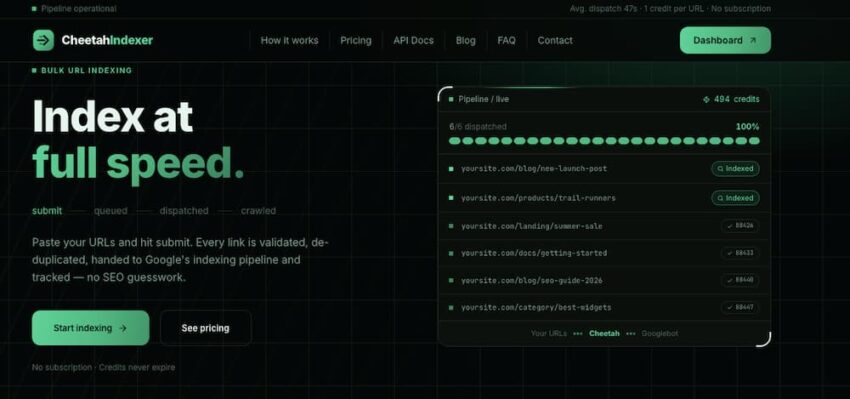
- Dashboard — After logging in, you land on a dashboard where submitted URLs and their indexing status are tracked.
- Account setup — Registration is straightforward: create an account, verify it, and you’re taken to the main dashboard.
- Credits — Cheetah Indexer, like most tools in this space, runs on a credit-based system where each submitted URL consumes credits.
- Backlink submission — URLs are submitted individually or in batches through the dashboard.
- Indexing workflow — Once submitted, the tool processes the URLs and begins sending discovery signals.
- API functionality — The platform offers an API key that can be generated from within the dashboard, useful if you want to integrate submissions into your own tools or scripts rather than pasting URLs manually each time.
- Monitoring/testing process — You can check submission status inside the dashboard to see whether a URL has been picked up.
- Overall user experience — In my experience, the interface was straightforward enough that beginners shouldn’t struggle, while the API option gives more advanced users room to automate.
I’d encourage you to check the official Cheetah Indexer website directly for the most current interface and feature details, since platforms update their dashboards and offerings over time.
How to Use Cheetah Indexer to Submit Backlinks
Here’s the general step-by-step process, based on how the platform is set up:
- Visit the Cheetah Indexer website and review what the tool offers.
- Create an account by signing up with your email.
- Choose a suitable package or amount of credits based on how many backlinks you plan to submit.
- Access the dashboard once your account and credits are set up.
- Prepare your backlink URL — the page containing the link you want indexed, not the link’s anchor text or the target site itself.
- Submit the backlink through the dashboard’s submission form.
- Generate an API key, if you plan to submit URLs programmatically instead of manually.
- Start the indexing process by confirming your submission.
- Monitor the status from the dashboard to see when or whether the URL gets picked up.
- Check the backlink page later using the
site:search operator or Search Console (if applicable) to confirm whether Google has actually indexed it.
This is a general workflow rather than an exhaustive list of every dashboard option, since interfaces can change. For the exact current buttons and screens, the video tutorial linked below shows the live process step by step.
Cheetah Indexer Live Backlink Indexing Test
Rather than just describing the tool in theory, I ran an actual test, which I recorded and posted on my YouTube channel.
Here’s what I did, in order:
- I first created a new backlink on a live page.
- I then submitted that backlink to Cheetah Indexer through the dashboard.
- I generated the required API key as part of the submission process.
- I monitored the backlink’s status after submission to see when it would show up.
In my test, the backlink appeared to be indexed after approximately 5 minutes. I want to be clear about what this does and doesn’t mean: this was the result for this one specific test, on this one specific URL, at this one specific time. It is not a guarantee that every backlink you submit will index in 5 minutes, or even that it will index at all. Indexing speed depends heavily on the target page’s own quality and crawlability, as covered earlier — the tool can send a signal, but it can’t override how Google evaluates the page itself.
During this particular test, conditions happened to be favorable — a reasonably crawlable page, a clean URL, and no technical blockers. Your results with any indexing tool, including this one, may look very different depending on your own backlinks.
How Long Does It Take to Index Backlinks?
There is no fixed, universal timeline for backlink indexing, and anyone promising an exact number for every link is not being fully accurate. In practice:
- Some URLs on well-established, frequently crawled sites may be discovered within minutes to hours.
- Others, especially on newer or low-authority sites, may take several days to a few weeks.
- Some pages may never get indexed at all, particularly if they’re thin, duplicate, or technically blocked.
Here’s a rough (not guaranteed) way to think about the variables at play:
| Factor | Typical Effect on Indexing Speed |
|---|---|
| High-authority, frequently crawled site | Often faster |
| New or rarely crawled site | Often slower |
| Clean, crawlable URL with no noindex/robots blocks | Faster |
| Blocked, broken, or redirect-heavy URL | Slower or never |
| Well-linked internally on host site | Faster |
| Orphaned page with no internal links | Slower |
| Original, useful content | More likely to be indexed |
| Thin or duplicate content | Less likely to be indexed |
Given all these variables, treat any specific “X hours” or “X days” claim from an indexing tool as a general expectation, not a promise.
Best Indexing Tool for Backlinks: What Should You Look For?
If you’re comparing options in this space, here’s a practical checklist to evaluate any backlink indexing tool against — Cheetah Indexer included:
- Ease of use — Can you submit URLs without a steep learning curve?
- URL submission options — Manual entry, bulk upload, or both?
- Bulk processing — Does it handle large batches efficiently if you’re running big campaigns?
- API availability — Useful if you want to automate submissions from your own systems.
- Reporting — Can you clearly see which URLs got indexed and which didn’t?
- Credit system — Is it transparent about how credits are consumed?
- Pricing — Does the cost make sense relative to your link volume?
- Transparency — Does the provider avoid unrealistic guarantees about Google’s behavior?
- Testing/results — Have you (or trusted sources) actually tested it, rather than relying only on marketing pages?
- Compatibility with your workflow — Does it fit into how you already manage link building and reporting?
There isn’t one objectively “best” tool for everyone — the right choice depends on your budget, the volume of backlinks you manage, and whether you need API access or just a simple submission dashboard. Cheetah Indexer is one option worth testing against this checklist rather than the only answer.
Cheetah Indexer Pricing and Credits
Cheetah Indexer operates on a credit-based pricing model, where credits are purchased and then spent on submitted URLs. Because tools in this space update their packages and pricing periodically, I’d rather not quote specific numbers here that could be outdated by the time you read this.
For current pricing, credit packages, and any available plans, check the official Cheetah Indexer website directly before purchasing.
=> Click Here to Visit Official Website of Cheetah Indexer
Pros and Cons of Using a Backlink Indexing Tool
Pros:
- Saves time compared to manually pinging or waiting for organic crawling.
- Centralizes URL submission and tracking in one dashboard.
- Useful for larger backlink campaigns where manual monitoring isn’t practical.
- Can simplify reporting and workflows, especially with API access.
Cons:
- Paid services cost money, which adds to your overall link-building budget.
- No tool can guarantee Google indexing — that decision always sits with Google.
- Results vary by URL, site authority, and content quality.
- Poor-quality backlinks may provide little SEO value even once indexed.
- Getting a backlink indexed does not, by itself, guarantee any ranking improvement.
Common Backlink Indexing Mistakes
A few patterns show up repeatedly among people struggling with backlink indexing:
- Assuming every backlink will get indexed — some pages simply won’t, regardless of the tool used.
- Using low-quality pages for backlinks — thin or spammy hosting pages are less likely to be indexed in the first place.
- Ignoring noindex or robots.txt restrictions — no indexing tool can override an explicit noindex directive.
- Building irrelevant backlinks — links from unrelated niches often provide limited value even when indexed.
- Expecting indexing to immediately boost rankings — indexing and ranking are separate stages.
- Relying entirely on indexing tools — without addressing on-page quality and technical accessibility, tools have less to work with.
- Not monitoring results — submitting links and never checking whether they actually got indexed wastes both time and credits.
Backlink Indexing vs Google Rankings
It’s worth repeating this clearly, since it’s one of the most common misunderstandings in link building: an indexed backlink does not equal a ranking boost.
Think of it as four separate stages:
- URL discovery — Google becomes aware the page exists.
- Crawling — Google actually visits and reads it.
- Indexing — Google stores it in the index.
- Ranking — Google’s algorithms decide how (and whether) that page, and any links on it, influence search results.
A link being indexed simply moves it into the pool of things Google is “aware of.” Whether that link actually helps your rankings depends on relevance, authority, anchor text, surrounding content, and dozens of other factors that indexing alone doesn’t address.
Watch the Cheetah Indexer Tutorial
If you’d rather see this process visually instead of reading through the steps, I documented the entire test on video — from the tool’s interface to the live indexing result.
The video covers:
- A full reveal and walkthrough of the tool
- An overview of the official website
- Pricing and package options as shown at the time of recording
- Account registration
- Buying credits
- Backlink submission
- Creating a fresh test backlink
- API key generation
- The live indexing test itself
- My final, honest review
Watch it here: https://www.youtube.com/watch?v=ctC4YSv-9dQ
If you want to see the complete Cheetah Indexer setup and live backlink indexing test in action, this is the easiest way to follow along step by step.
Frequently Asked Questions
How can I index backlinks fast in Google?
Focus on placing backlinks on crawlable, quality pages, improve internal linking and URL discoverability, and consider a backlink indexing tool for third-party links you don’t control. No method guarantees a specific speed.
What is the best indexing tool for backlinks?
There’s no single “best” tool for everyone. Evaluate options against criteria like ease of use, API access, bulk processing, transparency, and pricing, and test based on your own workflow.
How long does Google take to index a backlink?
It varies from minutes to weeks, depending on site authority, page quality, crawlability, and Google’s own crawling patterns. There’s no fixed timeline.
Can an indexing tool guarantee Google indexing?
No. Indexing is entirely controlled by Google. Tools can help surface URLs for crawling, but they cannot force indexing.
What is Cheetah Indexer?
Cheetah Indexer is a paid backlink indexing tool designed to help submit and monitor third-party backlink URLs for faster discovery by search engines.
Is Cheetah Indexer free?
No, Cheetah Indexer operates on a paid, credit-based model. Check the official website for current pricing.
How do I submit backlinks to Cheetah Indexer?
Create an account, purchase credits, and submit your backlink URLs through the dashboard, optionally using the API for automated submissions.
Can I index any link in Google?
Not necessarily. Pages with noindex tags, robots.txt restrictions, or very low quality may never get indexed regardless of the method used.
Does backlink indexing improve Google rankings?
Not directly. Indexing simply means Google is aware of the page. Ranking depends on separate factors like relevance, authority, and content quality.
Why are my backlinks not getting indexed?
Common causes include low site authority, thin or duplicate content, noindex directives, robots.txt blocks, poor internal linking, or Google simply not prioritizing the crawl yet.
Final Verdict
Getting backlinks indexed quickly comes down to a mix of fundamentals and smart use of available tools. Prioritizing crawlable, quality pages, strong internal linking, and easily discoverable URLs will do more for your indexing rate than any single tool ever could. On top of that foundation, a backlink indexing tool like Cheetah Indexer can be a useful addition to your workflow, especially for third-party links where you don’t control Search Console access.
Based on my test, Cheetah Indexer got one specific backlink indexed in around 5 minutes — a genuinely fast result for that particular URL, but not something to treat as a universal guarantee for every link you submit. As with any indexing tool, your results will depend on the quality and crawlability of the pages you’re working with.
If you want to see the full setup, pricing, and the live indexing test for yourself, the YouTube tutorial walks through the entire process visually — worth watching before you decide if it fits your own backlink indexing workflow.